99 Main Roles: Bicycle, Film Stars, Women's Lives – Ruth Orkin at the Little Castle
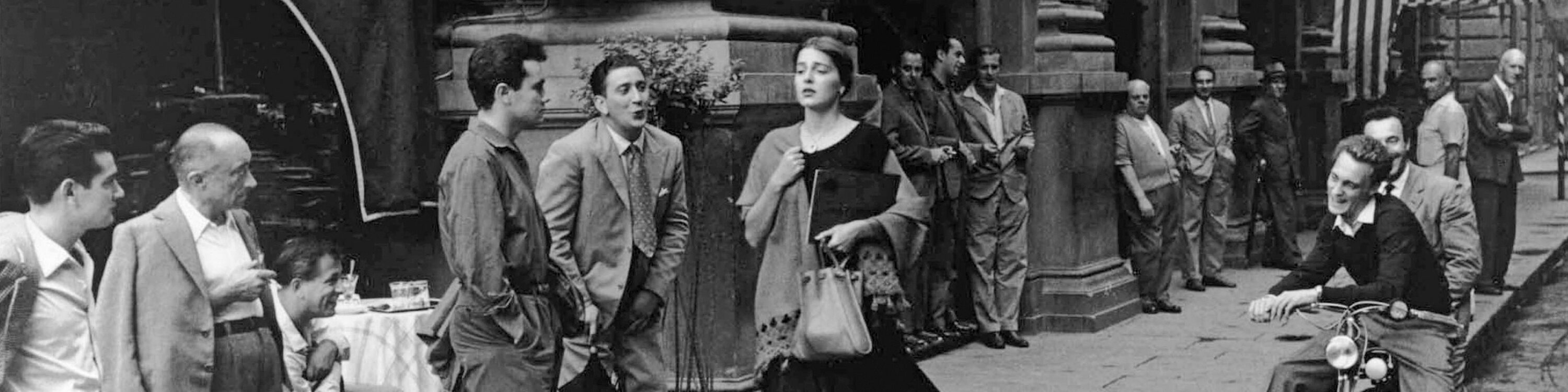
4 November 2026A young woman walks through Florence, attracting the attention of men. A child climbs between two sinks. A bicycle appears in front of American landmarks, as if it were on its own voyage of discovery. Ruth Orkin finds stories on the street, behind the scenes of Hollywood, and in the midst of everyday life. With the exhibition "Ruth Orkin – The World in Focus: Photographs between 1940 and 1960," the LUDWIGGALERIE invites visitors to get to know the photographer of the famous "American Girl in Italy." Curators Kerrin Postert and Nina Dunkmann explain what makes her perspective so special.
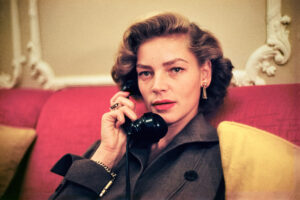
Ruth Orkin, Lauren Bacall, St. Regis Hotel, New York City, 1950 © OrkinEngel Film and Photo Archive, VG Bild-Kunst, Bonn, 2026
99 photographs, many stories
The journey to Oberhausen began with an offer from f³ – freiraum für fotografie in Berlin. Director Dr. Christine Vogt viewed the exhibition there. Later, the two curators also attended a presentation of the works in Nuremberg. For the Kleine Schloss (Little Castle), they ultimately selected 99 photographs from a loan list comprising approximately 150 works. The selection was based on the exhibition curated by Nadine Barth and Katharina Mouratidi, which was created in collaboration with the Ruth Orkin Photo Archive.
The aim was to develop a unique exhibition tour from a pre-existing selection. "The goal is to present Ruth Orkin as a photographer – in her entire career," explains Nina Dunkmann. Key works and important milestones in her life should be highlighted, as well as her different working methods. Among the numerous Hollywood portraits, for example, the focus had to be on a few particularly compelling images. In Oberhausen, familiar pictures are combined with new discoveries.
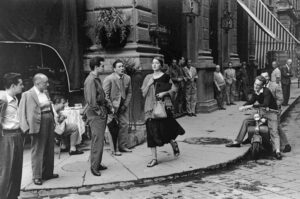
Ruth Orkin, American Girl in Italy, Florence, 1951 © OrkinEngel Film and Photo Archive, VG Bild-Kunst, Bonn, 2026
People in front of the camera
Orkin grew up in Hollywood as the daughter of a silent film actress and aspired to be a director herself. Photography opened up a different career path for her: In New York, she worked as a freelance photojournalist, and her photographs appeared in publications such as "Life," "Look," and the "New York Times." Her images are created with a keen sense of which moment tells a story.
People often seem barely to notice her presence. "Almost no one ever looks at the camera," says Kerrin Postert about Orkin's wanderings through the streets. People are playing, working, or going about their business. Orkin is also interested in what happens before a performance with prominent actresses: their arrival, getting their hair done, the preparation. "These are personal spaces she's allowed to glimpse," Postert reports.
The immediacy of her photographs by no means precludes conscious composition. Orkin studies the scene, positions herself, and occasionally makes subtle adjustments. "American Girl in Italy" is also part of a series she developed with her travel companion Jinx, exploring the experiences of women traveling alone. Observation and staging are intertwined.
Her enthusiasm for film remains palpable. Nina Dunkmann describes a photographer who thinks in stories and sequences of images – including what remains open between two shots and can be mentally filled in when viewing the work.
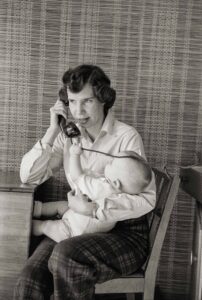
Ruth Orkin, Nancy Barnhardt, from the series Who Works Harder, New York, 1949 © OrkinEngel Film and Photo Archive; VG Bild-Kunst, Bonn, 2026
Who actually works harder?
The series "Who Works Harder?" from 1949 demonstrates how much can be revealed through close observation. Orkin accompanies a housewife and mother, as well as a working woman, through their daily lives. The question in the title sounds like a competition. The photographs make the answer more complex.
“She observes, but she doesn’t judge,” says Nina Dunkmann, who also contributes an essay to the accompanying booklet. Dunkmann has already experienced visitors not being able to immediately categorize the images. Even a working professional sets the breakfast table and takes care of laundry and household chores. Societal expectations don’t end at the office door.
For Dunkmann, this is a key idea behind the work: "So I think that she perhaps didn't just want to show how different they are, but also how similar they are." Orkin makes the women visible in different situations without defining them by their respective roles.

Ruth Orkin, Tirza between two washbasins, Tel Aviv, 1951 © OrkinEngel Film and Photo Archive; VG Bild-Kunst, Bonn, 2026
The special nuances
Nina Dunkmann's favorite photograph shows the girl Tirza climbing between two sinks in Tel Aviv. A small, everyday scene—yet the image is carefully composed: the child is seen from behind, the two sinks lend the composition symmetry, and light and dark areas structure the photograph. The snapshot and the graphic effect are inextricably linked. The photograph was taken in a children's home in Israel, yet it conveys joy, play, and lightness.
Kerrin Postert is particularly fascinated by the early "Bicycle Trip" series. In 1939, at the age of 17, Orkin embarked on her journey across the USA. Along the way, she photographed her bicycle in front of landmarks and landscapes. Postert is reminded of today's "Pics or it didn't happen": the bicycle serves as proof that the young photographer was actually there. In its recurring leading role, it almost acquires a personality of its own.
A child climbing, a bicycle on a journey, a familiar household chore: those who engage with Orkin's photographs can discover entire stories in inconspicuous details. The Little Castle offers this opportunity until February 14, 2027.
Joelle Czampiel
Curator-led tours every Sunday at 14 pm
- November and December 13, 2026 with Nina Dunkmann
- January 2027 with Kerrin Postert
Admission to the exhibition in the Little Castle and to the curator-led tours is free.
General