A walk-in picture book
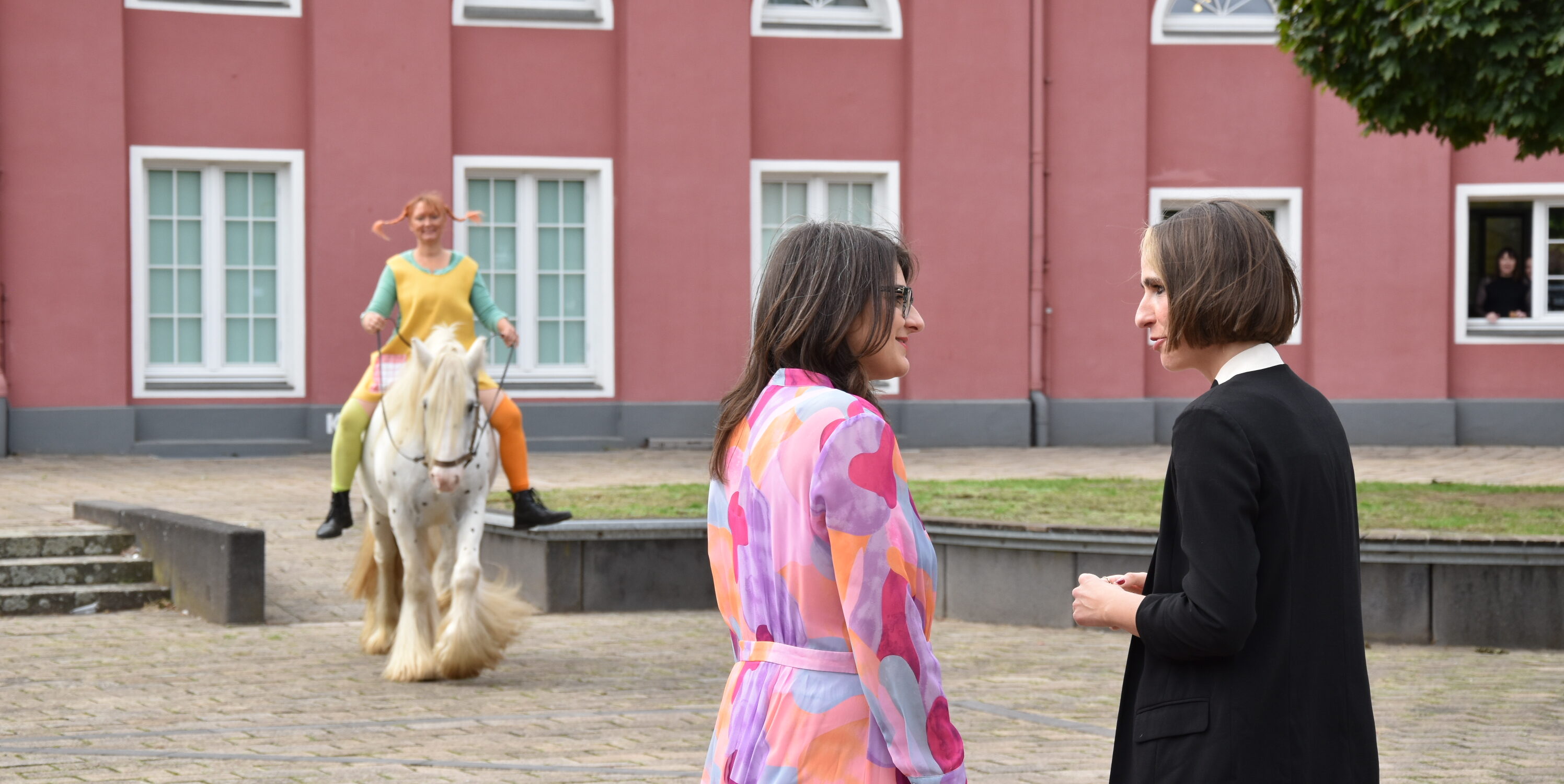
September 29, 2026Curators Dr. Sarah Hülsewig and Linda Schmitz-Kleinreesink discuss the art of illustration, surprising discoveries, and 570 original works from Astrid Lindgren's illustrated worlds.
Pippi's red braids, Emil's cap, or the familiar faces of the children from Bullerby: those who grew up with Astrid Lindgren's stories usually carry not only her characters but also very specific images in their memories. But who actually created these visual worlds? The exhibition "Pustekuchen, Schabernack und Plutimikation – Astrid Lindgren's World in Pictures" focuses for the first time on the artists behind the well-known characters. 570 original works by 13 illustrators show how differently Lindgren's stories can be told using ink, watercolor, acrylic, collage, and other techniques.
For curator Dr. Sarah Hülsewig, there is no question that these works belong in a museum: "Book illustrations are a very underrated art form – especially with a name like Astrid Lindgren, whose images have remained in our collective memory." Linda Schmitz-Kleinreesink also emphasizes the independent artistic quality of the works: "If this isn't art, what is? The illustrators draw, paint, create entire visual worlds and thus influence an incredible number of people."
Closer than in the book
Many of the exhibited motifs are already familiar to visitors from book pages or covers. In the museum, however, they encounter them in a completely new form. "On the original, you can see every single stroke of ink or brush," explains Sarah Hülsewig. This is particularly striking in Katrin Engelking's collages: only up close can you discover which excerpts from advertising brochures, samples, and small found objects are incorporated into her images. Details that are barely noticeable in the printed book stand out clearly in the original.
Linda Schmitz-Kleinreesink also points to the visible traces of the work process: bleed-through watercolor edges, test markings, retouching, or areas subsequently lightened with opaque white. Furthermore, the dimensions of the originals do not always correspond to the final print format. "It's something completely different to have this tactile original in front of you. Even though it's flat, the application of paint makes it appear almost three-dimensional." The exhibition thus offers not only a chance to rediscover familiar images, but also a glimpse into their creation.
Between collective memory and new discoveries
Given the worldwide reach of Astrid Lindgren's books, the selection could have been considerably larger. For the exhibition, the curatorial team focused on those illustrators whose pictures were published in German-speaking countries. "We wanted to engage our audience and activate the collective memory," explains Sarah Hülsewig. After all, it is precisely these illustrations that have shaped the appearance of Pippi, Emil, Lotta, and many other characters in this country for generations.
Which original works can actually be shown, however, depends not only on the curatorial concept. "It's always a combination of the questions: What story do I want to tell – and what am I actually able to get?" explains Linda Schmitz-Kleinreesink. Some estates and publishers hold extensive collections, while other works cannot travel or be exposed to light for extended periods due to conservation reasons. The selection thus arises from considerations of content, available loans, and the question of whether to present a complete story or as many different facets of an artist's work as possible.
Instead of presenting Astrid Lindgren's work chronologically, the curators opted for a structure based on stories and characters. Linda Schmitz-Kleinreesink describes the exhibition as "a walk-through picture book where you can immerse yourself in your favorite stories." Dedicated sections focus on characters such as Pippi Longstocking, Emil of Lönneberga, Bullerby, and fairy tales. The exhibition isn't solely about familiar motifs, however. It also explores Lindgren's attitude towards children, her connection to nature, and central themes like freedom, self-determination, and imagination.
Although the illustrations span many decades, the depicted worlds have changed less than one might expect. The artists adhered closely to the source texts, whose historical setting remained unchanged. Changes are more evident in clothing, production methods, and artistic techniques. Particularly in the work of Ilon Wikland, who illustrated some stories multiple times, it is possible to trace the evolution of her visual language.
A little bit of Bullerby in Oberhausen
During the preparations, the curators also encountered stories and motifs that were previously largely unknown to them. Sarah Hülsewig rediscovered, in particular, less popular fairy tales and story collections. She was especially impressed by Hans-Joachim Krantz's illustrations for "In the Land of Twilight." Linda Schmitz-Kleinreesink, in turn, was surprised by the sheer volume of material: "It was incredible for me to see how productive the individual illustrators were and how much Astrid Lindgren wrote. The stories and illustrations represent an unbelievable amount of work."
Who is this abundance aimed at? Linda Schmitz-Kleinreesink puts it succinctly: "Everyone." Children can discover characters and stories at their own eye level – some original artworks have been hung accordingly low. Adults encounter images from their childhood, parents stories they read to their children, and grandparents perhaps illustrations that are no longer published.
Thus, "Astrid Lindgren's World in Pictures" is both a space for remembrance and a rediscovery. Or, as Linda Schmitz-Kleinreesink puts it: Anyone who hasn't yet come into contact with Astrid Lindgren can now do so – and treat themselves to "a little bit of Bullerby in Oberhausen".
Joelle Czampiel
General