Making of FIX & FOXI
June 29, 2018
How is a comic book created? And how does digitalization change
this industry? Bone Buddrus is the chief illustrator of the last Fix &
Foxi print edition, published in 2010. At the weekend he gave a very lively comic workshop in
the LUDWIGGALERIE Schloss Oberhausen.
Before the practical part began at the drawing tables, the audience was given an insight into the working methods of a draftsman:
It takes about 20 minutes to read through a comic book –
It is all the more astonishing that the production of only a single page of a
Large number of employees is required. First of all, it is Authorto write a story. In the form of a scripts This is the Storyboard
defined, which already provides a rough Layout
is Panel-orders.
The script also contains the dialogues that will later appear in the Speech bubbles appear.
 |
|
Making of Fix & Foxi, workshop with Bone Buddrus,
2018 © LUDWIGGALERIE Schloss Oberhausen
|
Now it is the task of the draftsman,
to convert the instructions of the script into a drawing. There can also be
It can sometimes happen that the artist has to shorten the dialogues. "I'm not going to draw a panel that just consists of speech bubbles!"
Buddrus emphasizes and shows the audience via projector presentation the final artwork a comic page:
 |
|
Making of Fix & Foxi, workshop with Bone Buddrus,
2018 © LUDWIGGALERIE Schloss Oberhausen
|
“Lupo, Fix & Foxi are shooting a film. When the film crew
When they return from filming, they are horrified to discover that the entire camp is in ruins!”
When they return from filming, they are horrified to discover that the entire camp is in ruins!”
That was roughly what the script said."Well, how can you describe the
Describe the condition of a devastated camp?“, asks Buddrus with a slightly desperate
Facial expression. With such tricky instructions, you can sometimes
a computer-animated 3D model
The amount of “destroyed” camp mobiles can be reduced in the future
convincingly and, above all, quickly. “After all, you only got 175 euros for drawing a
comic page – and that takes a whole working day!”
 |
|
Making of Fix & Foxi, workshop with Bone Buddrus,
2018 © LUDWIGGALERIE Schloss Oberhausen
|
In general, it should be emphasized that most illustrators today
using a graphics tablet on the computer. Previously, the sketched blue drawing at one Tuscher passed on, which with
black ink to draw the final lines. During the subsequent
Copying this revised blue drawing, the blue lines were
invisible – the black final artwork.
Today, both steps are usually done on the computer."This is still handwork, folks!”, Buddrus assures the
Audience.
 |
|
Making of Fix & Foxi, workshop with Bone Buddrus,
2018 © LUDWIGGALERIE Schloss Oberhausen
|
When it comes to the portrayal of the individual characters, the
Using a so-called Style Guides
absolutely necessary: "How big is Foxi
compared to Lupo? In which house does Lupo live? What exact color does
Foxi's yellow dungarees? How do the body movements of the
two fox twins? Remember, Fix is much smarter than Foxi!” Such
external features are defined in the Style Guide and are regularly updated
adapted to the respective contemporary taste.
 |
|
Making of Fix & Foxi, workshop with Bone Buddrus,
2018 © LUDWIGGALERIE Schloss Oberhausen
|
All participating signatories are obliged to adhere to
to keep the most up-to-date style guide. This is the only way to ensure a uniform
character style that provides the necessary recognition value of Fix
& Foxi. This becomes even more important when several artists are involved
a single panel. Projected on the wall in large format,
Buddrus cites such a case:
 |
|
Making of Fix & Foxi, workshop with Bone Buddrus,
2018 © LUDWIGGALERIE Schloss Oberhausen
|
“The tied up Lupo is taken on a sledge by a
Kidnapped by a bandit group. Grandma Eusebia, Lupinchen and Pauli start a chase
The fast-paced scene takes place in an evening snowy landscape."
Kidnapped by a bandit group. Grandma Eusebia, Lupinchen and Pauli start a chase
The fast-paced scene takes place in an evening snowy landscape."
Based on the script, a first sketch was made, which
Buddrus as chief draftsman submitted
He personally felt that a certain dynamism was missing within the
landscape depiction, after which he made some changes with red:
Buddrus as chief draftsman submitted
He personally felt that a certain dynamism was missing within the
landscape depiction, after which he made some changes with red:
 |
|
Making of Fix & Foxi, workshop with Bone Buddrus,
2018 © LUDWIGGALERIE Schloss Oberhausen
|
He sent this revised sketch back to the
The draftsman, in turn, converted the proposal into a final drawing
around:
 |
|
Making of Fix & Foxi, workshop with Bone Buddrus,
2018 © LUDWIGGALERIE Schloss Oberhausen
|
The drawing is then sent to the colorist In this case it was Buddrus himself who
suggested the colour scheme in evening violet tones. After all, in
Script speaks of an “evening snow landscape”!
suggested the colour scheme in evening violet tones. After all, in
Script speaks of an “evening snow landscape”!
 |
|
Making of Fix & Foxi, workshop with Bone Buddrus,
2018 © LUDWIGGALERIE Schloss Oberhausen
|
Nevertheless, the top management rejected his
color version. People wanted a brighter snow landscape and
finally agreed on the following version:
color version. People wanted a brighter snow landscape and
finally agreed on the following version:
 |
|
Making of Fix & Foxi, workshop with Bone Buddrus,
2018 © LUDWIGGALERIE Schloss Oberhausen
|
Buddrus is a true entertainer and conveys
The audience was able to learn in a very lively way about the different professions within the
Comic industry – remarkable how many employees and work steps
required to produce a print edition! A shared studio,
like the castle near Munich, which Kauka made available to his employees in 1956
can make work processes much easier. The catch:
Many of the Kauka artists lived abroad. And so they sent the
Documents are often sent back and forth by post – across Europe. Nowadays,
This is much faster by email; in general, the Digitalization some people
work step. But: “Partly knows
you don't even know the people you work with personally"
notes Buddrus.
Speaking of the Internet and digitalization, Mr. Buddrus: “What is your opinion on the computer-animated
Fix & Foxi characters that have recently been appearing on television screens"
asks a guest in the audience.The
three-dimensional representation of comic characters that have their graphic origin
in two dimensions is generally a challenge,” replied
the illustrator. For example, it is
difficult to show Lupo in frontal view,
"because his nose is sooooo huge,
that it would cover his entire face!".
 |
|
Making of Fix & Foxi, workshop with Bone Buddrus,
2018 © LUDWIGGALERIE Schloss Oberhausen
|
The same applies to the left and right protruding
Fox ears from Fix & Foxi.
Fox ears from Fix & Foxi.
 |
|
Making of Fix & Foxi, workshop with Bone Buddrus,
2018 © LUDWIGGALERIE Schloss Oberhausen
|
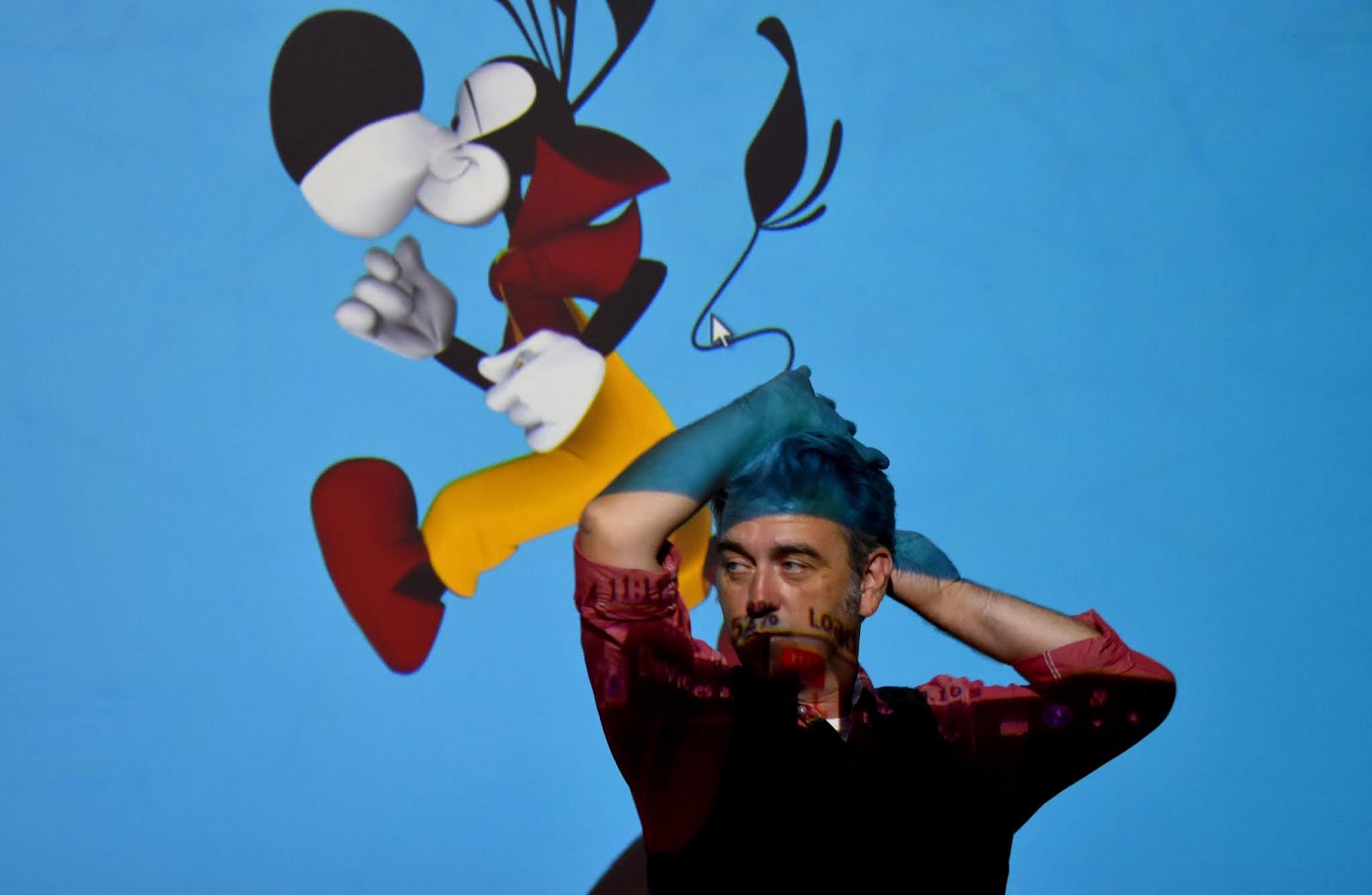
“For this reason
The characters in hand-drawn comics are almost always in a light
side view shown!”, explains the artist, while showing us the
Positioning of the fox ears from the side view.
 |
|
Making of Fix & Foxi, workshop with Bone Buddrus,
2018 © LUDWIGGALERIE Schloss Oberhausen
|
“This perspective
Incidentally, Mickey Mouse also has displaced ears.”
Incidentally, Mickey Mouse also has displaced ears.”
 |
|
Making of Fix & Foxi, workshop with Bone Buddrus,
2018 © LUDWIGGALERIE Schloss Oberhausen
|
No sooner said than done! After this very impressive presentation,
it over to the museum education room. Here Buddrus showed the
Workshop participants the most important tricks for figure representation.
it over to the museum education room. Here Buddrus showed the
Workshop participants the most important tricks for figure representation.
 |
|
Making of Fix
& Foxi, Workshop with Bone Buddrus, 2018 © LUDWIGGALERIE Oberhausen Castle
|
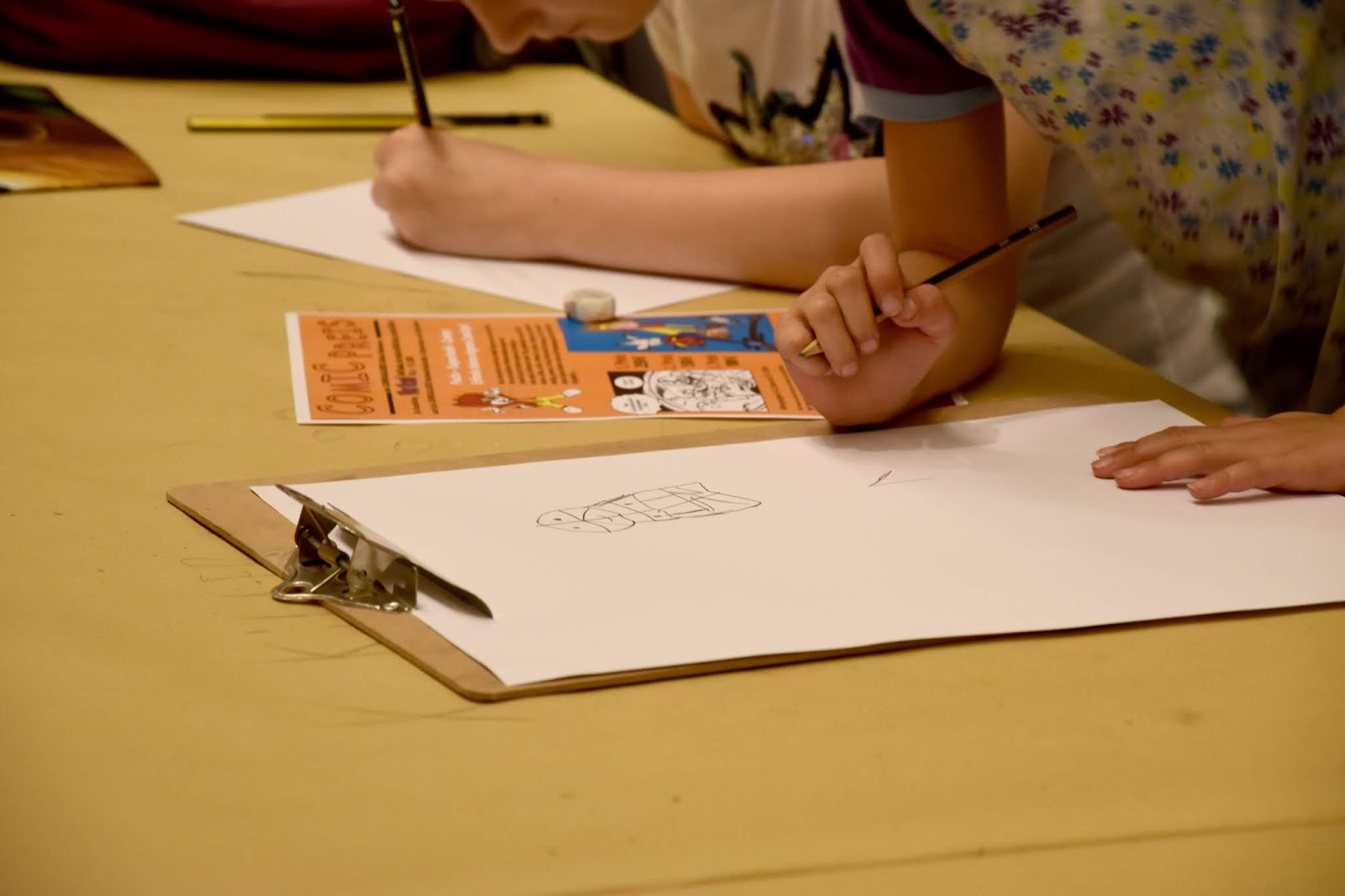
Children, teenagers and even adults grabbed pens
and clipboard to try your hand at drawing a fox.
and clipboard to try your hand at drawing a fox.
 |
|
Making of Fix & Foxi, workshop with Bone Buddrus,
2018 © LUDWIGGALERIE Schloss Oberhausen
|
Anyone who has seen the originals by Buddrus and the early Kauka artists
If you want to see the exhibition
“FIX & FOXI. Rolf Kauka, the German Walt Disney, and his cult foxes” in
the LUDWIGGALERIE Schloss Oberhausen. (10.6.-9.9.2018)
If you want to see the exhibition
“FIX & FOXI. Rolf Kauka, the German Walt Disney, and his cult foxes” in
the LUDWIGGALERIE Schloss Oberhausen. (10.6.-9.9.2018)
+++ In 2018, the LUDWIGGALERIE Schloss Oberhausen celebrates
20th anniversary +++
20th anniversary +++
 |
|
Self portrait
Bone Buddrus © Bone Buddrus
|
Professional career of Bone Buddrus:
Born in 1969 in Castrop-Rauxel, Bone Buddrus, after
his Abitur and community service, he studied art in Essen. Here
He specializes in animation together with a fellow student.
He then worked for television productions in storyboarding,
Layout, character design and animation. Jobs for various companies follow
the games industry. As graphic director, he deals with digital
Image manipulation and computer animation. But also as a sound director and copywriter
He is active during this time. Ultimately, he remembers his “old
Love” and becomes self-employed as an illustrator.
Author: Natascha Kurek
Events & Projects Artists